

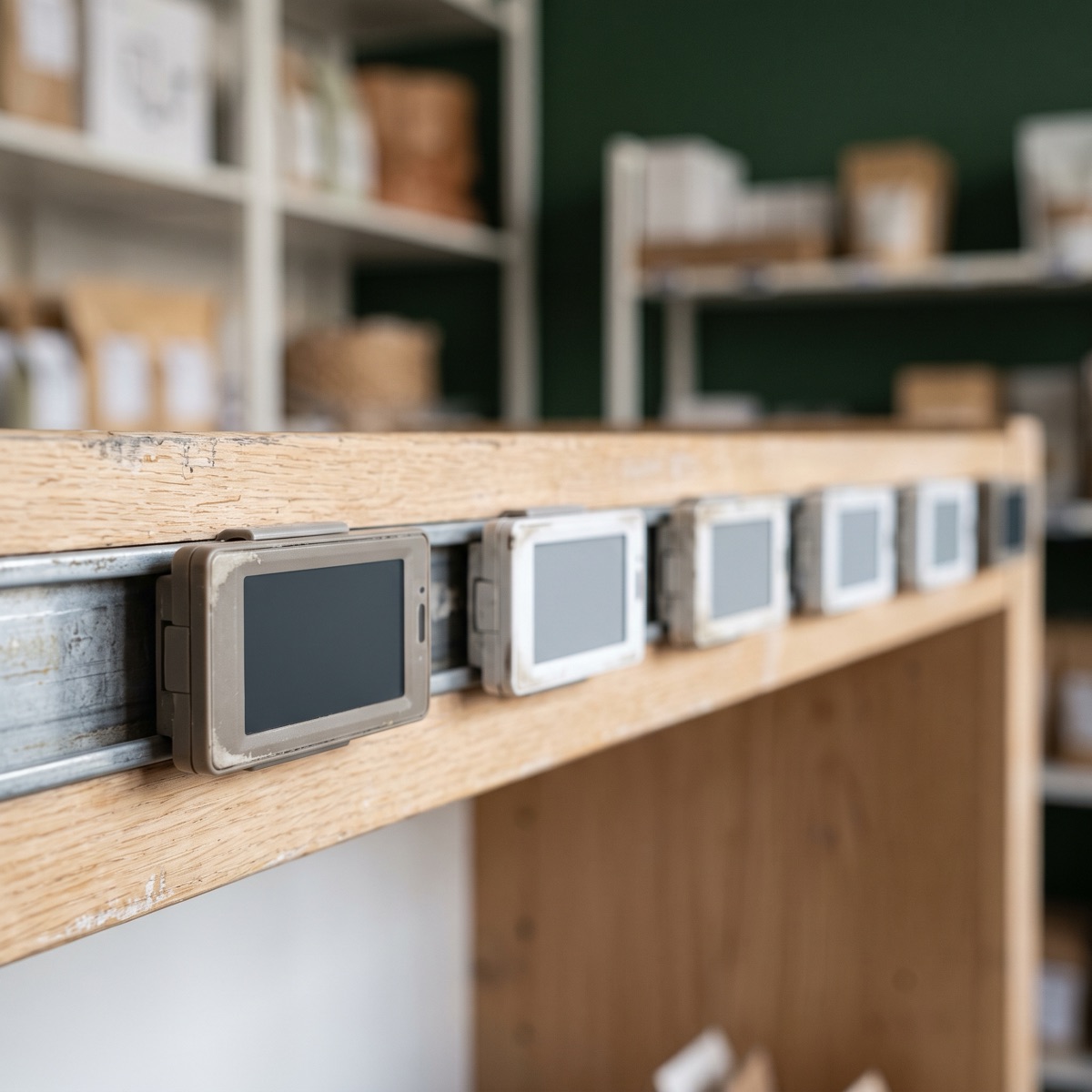
There are three places a workplace display spends its environmental budget: making it, running it, and disposing of it. Almost every sustainability claim discusses the second, because it is the only one a specification sheet can quantify.
For a small screen on a wall, the manufacturing and disposal ends are not a rounding error against the running cost. They are frequently the larger part, and they scale with how often the thing is replaced.
Running cost: real, and smaller than it looks
E-paper genuinely wins here, and the mechanism is worth understanding rather than taking on trust. E Ink states that its screens are bi-stable and only the regions of the screen that are changing require updating. The image is held by the physical position of charged particles, not by continuous power. An LCD redraws continuously; e-paper draws only when something changes. The physics is covered in why an e-paper panel runs for years on one battery.
But be honest about the scale. One small panel on one door is not a significant load either way. It becomes significant when multiplied across an estate. Two hundred doors across six buildings, and that is the frame in which the comparison is worth making, not per door.
The bigger lever: how often it gets replaced
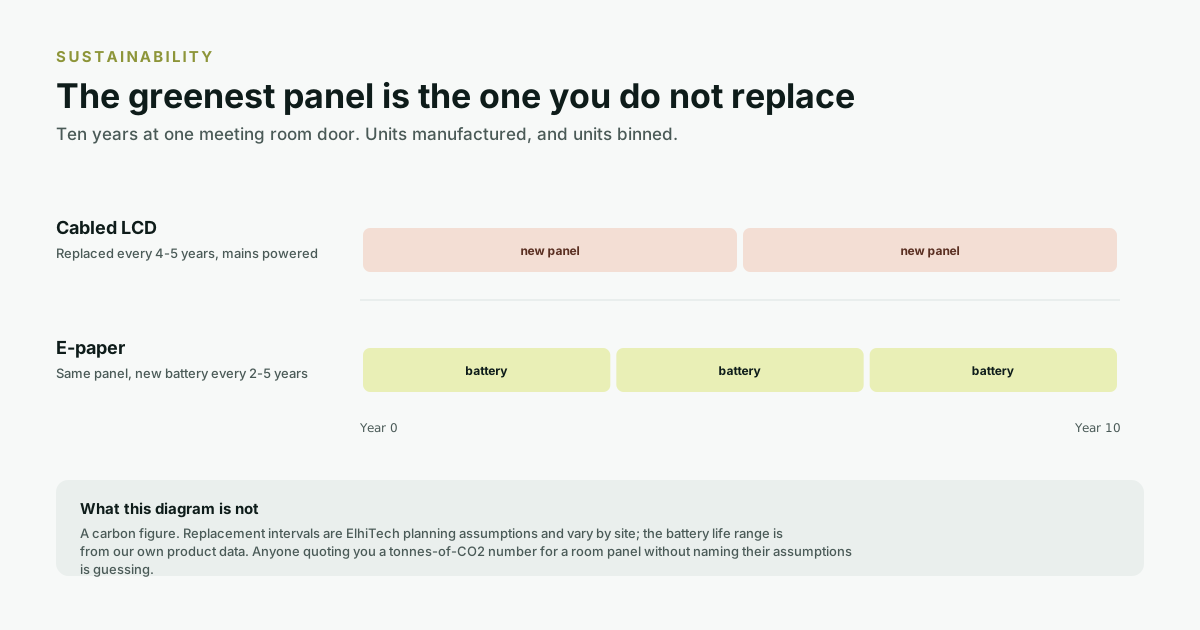
A display that is replaced every four years produces two and a half times the manufacturing and e-waste footprint of one replaced every ten, regardless of what either draws while running. Replacement is driven by things that have little to do with the panel:
- The mount and the cable become obsolete before the glass does. A refit changes the wall, and the panel goes with it.
- A failed component takes the whole unit. Small displays are rarely economically repairable, so a failed power supply is a new panel.
- Software support ends. A panel running an OS that no longer receives updates gets replaced for security reasons while the hardware is fine. This is a real and underrated driver.
- The estate is reconfigured. Coworking floors especially. A panel that cannot be moved without an electrician often is not moved; it is abandoned and a new one fitted.
That last point is where the cabling argument and the sustainability argument turn out to be the same argument. A battery panel that can be unscrewed and remounted two metres away survives a reconfiguration. A cabled one frequently does not.
What e-paper actually changes here
Setting out both sides.
| Claim | Status |
|---|---|
| Draws no power to hold an image | True, and sourced to E Ink's own description of bistability. |
| Avoids electrical and containment work at install | True. Less material and less builders' work per door. |
| Survives a floor reconfiguration | Usually true, because it can be remounted without a trade. |
| Adds batteries to the waste stream | True, and a genuine cost against it. |
| Has a lower manufactured footprint than an LCD | Unproven by us. We have no comparative LCA and will not claim one. |
| Reduces your reported Scope 2 emissions | Marginally, at estate scale. Not a headline number. |
The battery row matters. Replacing a battery every two to five years across two hundred panels is a waste stream that did not exist before, and it needs a collection route rather than a bin. Anybody presenting e-paper as environmentally free is skipping that.
Questions that actually surface the footprint
If you are evaluating displays on environmental grounds, these get further than a power figure.
- How long will you supply software updates for this device? This often determines replacement date more than hardware life does. Get a year, in writing.
- Is the battery user-replaceable, and do you take the old ones back? A take-back route is the difference between a managed waste stream and two hundred batteries in a facilities cupboard.
- Can this panel be moved to a different wall without a trade? That is your reconfiguration survival rate.
- What is the repair path for a failed unit? If the answer is replacement, that is the real lifecycle regardless of the specified lifespan.
- What happens to the old panels when we upgrade? Ask specifically whether the vendor takes them back or whether disposal is yours.
- What is the warranty, and what does it cover after year three? Warranties frequently expire the year before replacement becomes likely.
The claim we will make
Not that e-paper is green. That it removes the cabling from the door, and the cabling is what makes a panel expensive to install, expensive to move, and therefore likely to be discarded rather than relocated when the floor changes. Fewer panels manufactured, over the same ten years, at the same door.
That is an argument about longevity rather than about power draw, and it is the one we would want a procurement team to interrogate. The cost side of the same argument is in what a screen on a meeting room door actually costs.
Where truink sits
truink panels run on battery over BLE with no power or network cabling, specified at two to five years per battery. ElhiTech lists sustainability as one of its five pillars, and the paragraph above is what that pillar amounts to in practice.
Frequently asked questions
Are e-paper displays more environmentally friendly than LCDs?
On running power, yes. E-paper is bistable and draws energy only when the image changes. On manufactured footprint we have no comparative lifecycle assessment and will not claim one. The stronger argument is longevity: a panel that can be moved without an electrician is less likely to be discarded during a refit.
How much carbon does a meeting room display produce?
We do not publish a figure, because a defensible one would depend on the panel, the factory, the grid mix where it was manufactured and where it runs, shipping and disposal routes. A single number quoted without naming those assumptions is an estimate.
What actually determines how long a workplace display lasts?
Rarely the screen. Software support ending, a failed non-repairable component, a refit that changes the wall, or a reconfiguration the panel cannot be moved through. Cabled panels are frequently abandoned rather than relocated, which is a replacement nobody counted.
Do e-paper panels create battery waste?
Yes, and it is a genuine cost against them. A battery change every two to five years across a large estate is a waste stream that did not previously exist, and it needs a collection and disposal route rather than a cupboard.
What should I ask a display vendor about sustainability?
How long software updates will be supplied, whether the battery is user-replaceable and taken back, whether the panel can be relocated without a trade, what the repair path is for a failure, and what happens to old units at upgrade. These reveal the replacement cycle, which dominates the footprint.
Does switching to e-paper meaningfully reduce our emissions reporting?
Marginally, and at estate scale rather than per door. A single small panel is not a significant load either way. The larger effect is on how many panels get manufactured over a ten-year period, which is a longevity question rather than a power one.