

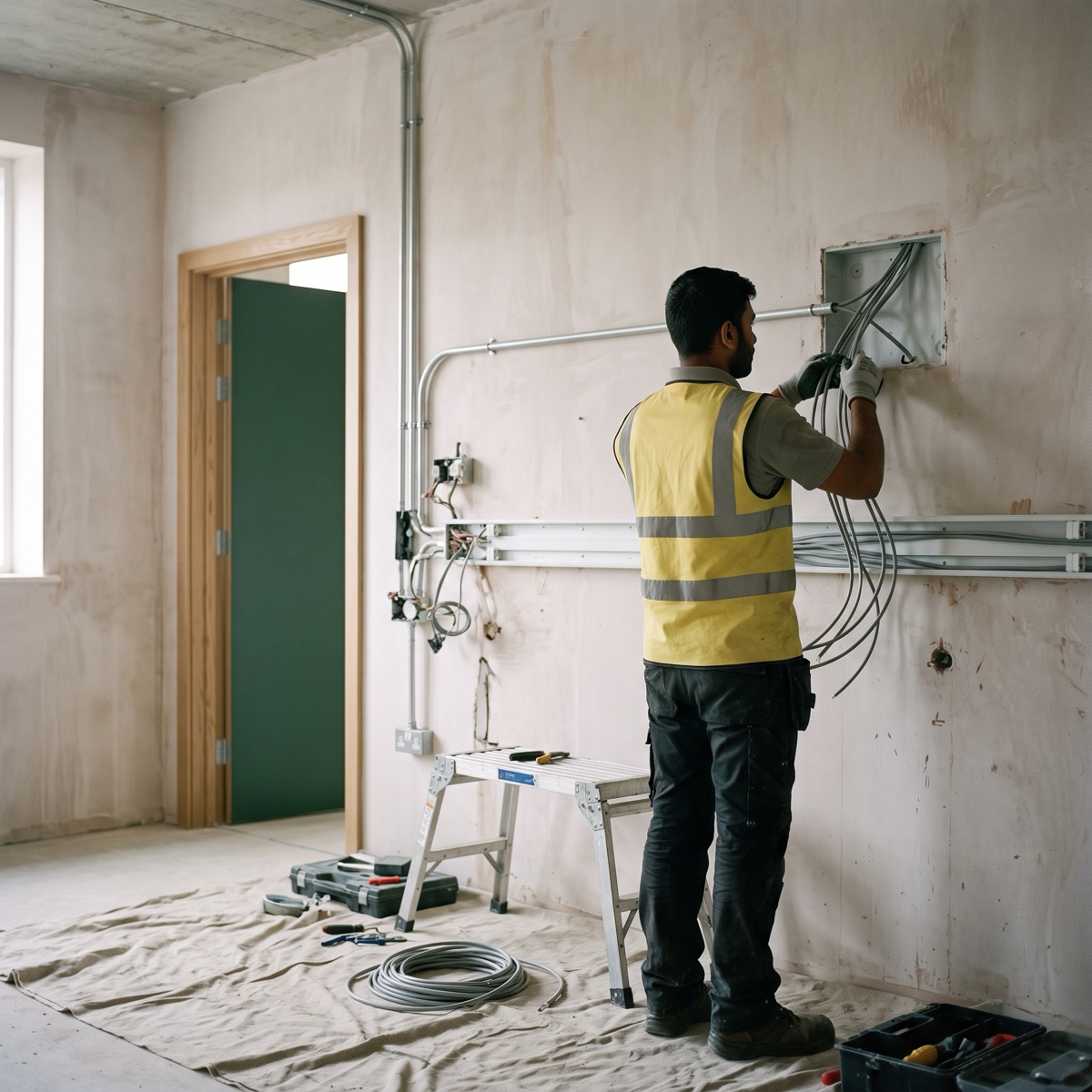
A meeting room panel project gets budgeted as hardware and delivered as construction. That mismatch is why so many of them stall between approval and installation, and why the second phase of a rollout so often never happens.
Below is every line item we have seen in these projects. The aim is not to attach a rupee figure to each, since those vary by site, but to show which ones exist at all. That is the part a hardware quote leaves out.
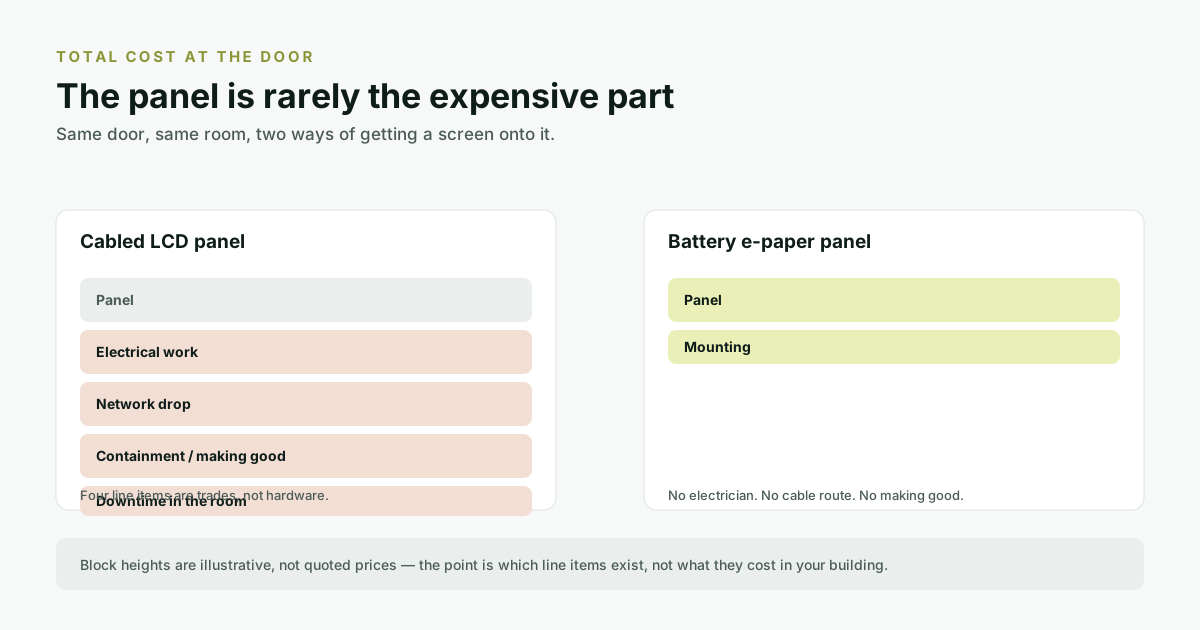
The line items in a cabled panel
- The panel. The only line most quotes contain.
- Mounting. Bracket, fixings, and a decision about whether it goes on glass, plasterboard or a structural wall.
- Electrical work. A licensed electrician, a spur from the nearest distribution board, and whatever the route requires. In a finished fit-out this is the item that moves the total.
- Network. Either a data drop with the same route problem, or Wi-Fi and a conversation with IT about putting a display device on the corporate network.
- Containment and routing. Trunking, conduit, floor boxes, or a channel cut through a glass partition frame. On a listed or leased building, possibly a landlord approval too.
- Making good. Filling, patching and repainting the route afterwards.
- Room downtime. The room is not bookable while the work happens, on a floor where rooms are the scarce resource.
- Coordination. Somebody has to schedule the electrician, the network engineer and the AV installer into the same week, out of hours, in an occupied office.
What a battery panel removes
A battery-powered e-paper panel talking over BLE removes items 3 through 8 entirely. What is left is the panel and the bracket, and an install that a facilities team can do themselves between meetings.
The claim is not that e-paper is cheaper per unit; compare like for like and panel prices sit in similar territory. It is that six of the eight line items stop existing.
Doing the arithmetic for your own building
This is worth working out against your own building rather than a generic figure. Three steps:
- Count the doors, not the rooms you care about most. A rollout is priced on the total, and the doors furthest from a socket are the ones that blow the estimate.
- Get one electrical quote for the worst door in the building, the one across the atrium, or behind the glass partition. Multiply nothing yet; just look at that number next to the panel price.
- Ask your facilities team how many out-of-hours slots they can realistically get in a quarter. This is usually the real constraint on a phased rollout, and it is the one nobody budgets.
The comparison worth running
Our own deployment calculator puts cabled LCD and battery e-paper side by side with every coefficient visible on screen, so you can replace our assumptions with your own quote. Only the e-paper panel price in it is an ElhiTech figure; everything else is explicitly labelled as a planning assumption, for exactly the reason above.
When the cabled panel is still the right answer
If power and network already terminate at the door, as in a new fit-out where the AV design anticipated panels, or a building where the doors happen to sit beside existing outlets, then most of the cost above never appears, and the decision should be made on capability instead. That comparison is in where e-paper wins and where it does not.
What to ask a vendor
- Does your quote include electrical work, network provision, containment and making good, or is it hardware only?
- Who carries the risk if a door turns out to need a longer cable route than surveyed?
- How many doors can you install in one out-of-hours window?
- What does the second phase cost, when the easy doors are done and only the awkward ones are left?
- If we move a room in eighteen months, what does relocating the panel involve?
Where truink sits
truink panels run on battery over BLE 5.0 with no power or network cabling at the door, which is what removes those six line items. They are driven by truRooms, which also drives cabled panels, so if your building genuinely has power at every door, the software argument does not change.
Frequently asked questions
What does a meeting room booking panel cost?
The panel itself is usually the smallest line item. A cabled installation also carries electrical work, a network drop, containment and routing, making good afterwards, room downtime and trade coordination. In a finished building those together typically exceed the hardware, though the amount is highly site-specific.
Why is installing a room panel so expensive in an existing office?
Because getting mains power and a network connection to a door in a completed fit-out means a licensed electrician, a cable route through finished surfaces, containment, and repairing the route afterwards. Usually out of hours, with the room unavailable while it happens.
Do battery-powered panels really avoid all the installation cost?
They avoid the cabling-driven items: electrical work, network provision, containment, making good, room downtime and trade coordination. What remains is the panel and its mounting bracket, which a facilities team can typically fit without an external contractor.
Is e-paper cheaper than an LCD panel?
Not necessarily per unit. Comparable panels sit in similar territory. The saving is in installation, and it only exists where the door does not already have power and network. Where those are already present, compare on capability rather than cost.
How should I estimate this for my own building?
Count every door rather than the rooms you care about, get one real electrical quote for the most awkward door in the building, and ask facilities how many out-of-hours installation windows they can realistically secure in a quarter. That last constraint usually decides the rollout schedule.
Why does this post not give rupee figures?
Because electrical and builders' work costs vary by city, building age, landlord and whether the floor is occupied, and we have no sourced benchmark we would stand behind publicly. A single national figure for that work would not survive contact with a real site.