


Workplace sensing gets discussed as though it were one thing. It is not. A camera doing facial recognition and a passive infrared sensor counting warm bodies are both "occupancy sensing" in a brochure and entirely different propositions in law, in ethics, and in the conversation you will have with your works council or your employees.
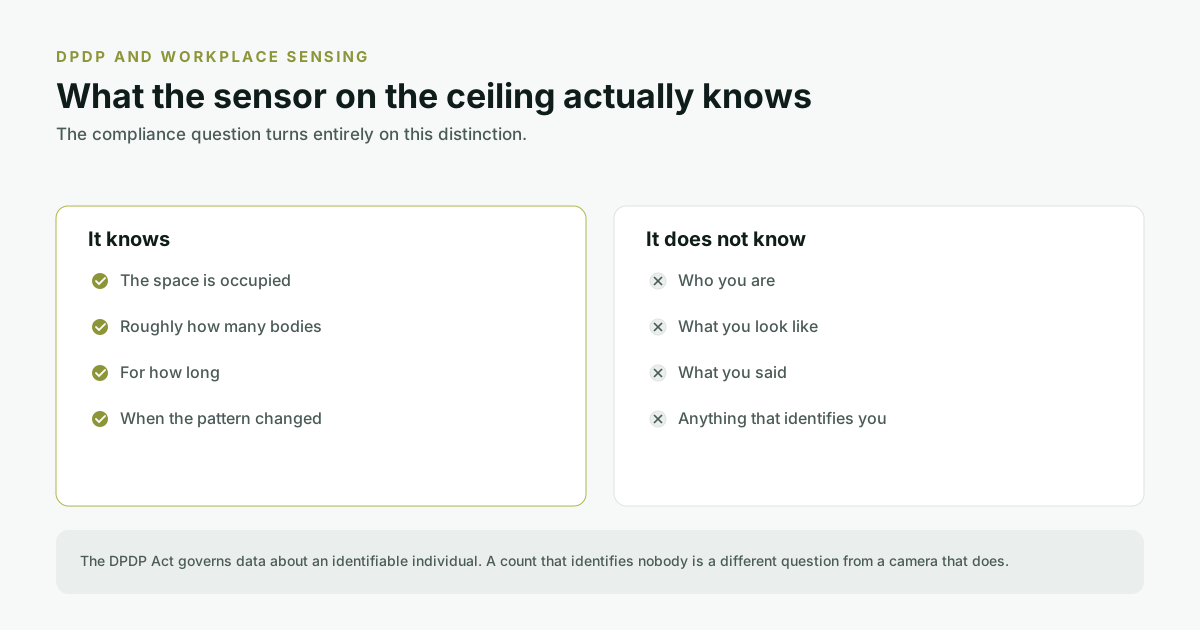
What the Act actually covers
India's Digital Personal Data Protection Act, 2023 defines personal data as data about an individual who is identifiable by or in relation to that data. That definition is the whole hinge. If a system produces data from which an individual can be identified, the Act's obligations attach. If it produces a number that could not be traced to a person by anyone, the analysis is different.
The Act also provides, at Section 7, for certain legitimate uses where consent is not required, and employment is among them. That matters for workplace deployments, but it is not the blanket permission it is sometimes described as. It is a basis for processing, not an exemption from the rest of the Act.
What a PIR occupancy sensor knows
A passive infrared sensor detects changes in infrared radiation across its field of view. It produces, in effect, a count and a timestamp.
| It can tell you | It cannot tell you |
|---|---|
| The space is occupied | Who is in it |
| Roughly how many bodies are present | What they look like |
| For how long | What they said |
| When the pattern changed | Their role, team or employment status |
| That a room booked at 10:00 was empty | Which individual failed to turn up |
That last row is the interesting one. "This room was booked and nobody came" is an operational fact about a room. "Priya booked this room and did not come" is a fact about Priya. The sensor produces the first. Joining it to the booking system produces the second.
The join is where the risk lives
This is the point most sensing discussions miss. The sensor is rarely the problem. What makes workplace sensing sensitive is combining anonymous occupancy data with a system that knows who people are: the booking calendar, the access control log, the desk reservation, the Wi-Fi association table.
Any one of those alone is defensible. Joined, they produce a record of where a named individual was and for how long, which is a substantially different thing to hold and to justify.
- Occupancy alone: a count per space per interval. Hard to attribute to anyone.
- Occupancy plus room bookings: now attributable to whoever booked, which is usually a named person.
- Occupancy plus access control: now a movement record for a named individual.
- Occupancy plus desk booking: now a presence-and-attendance record, which is a workplace-relations question before it is a legal one.
Questions to settle before you install anything
- What is the smallest unit we report on? A floor is safer than a zone; a zone is safer than a single desk. On a floor with four people, a per-zone count is a per-person count in practice.
- Do we join sensing data to identity, ever? If yes, name the specific report that requires it and who sees it. If no, enforce that in the data model rather than in a policy document.
- How long do we keep it? Space planning needs months of aggregate trend, not two years of per-minute records. Retention is the cheapest risk reduction available.
- Who can query it, and can they query an individual? A dashboard that permits filtering to one desk on one day is a surveillance tool regardless of what it was built for.
- Have we told people? Not buried in a handbook. Signage in the space, and an explanation of what the sensor can and cannot see. This is where most of the trust is won or lost.
- What would we do if an employee asked for their data? If the honest answer is "we could not identify any data as theirs", that is a strong position, and worth being able to demonstrate.
Why cameras are a different conversation
A camera doing people-counting is not obviously worse than a PIR sensor in what it reports. It is meaningfully worse in what it could report, and in what employees will reasonably assume it reports. The gap between those two is not closed by a policy document, because nobody walking under it can verify your policy from the corridor.
If you can meet the requirement with a sensor that is physically incapable of identifying anyone, that is worth more than an equivalent capability with a stronger policy wrapped around it. It is an argument you can make to employees without asking them to take your word for anything.
Where truIoT sits
truIoT covers occupancy and presence sensing, including truOccupancy and sPresence, on an open architecture with an on-premise soft gateway option. The on-premise path matters for exactly this conversation: for organisations whose answer to "where does this data go" has to be "nowhere outside our network", that has to be an architectural fact rather than a contractual promise.
What the data is for is covered in hot desking does not fail on hardware. The honest occupancy figure is the input that makes a flexible workplace programme work, and it is the reason to collect any of this.
Frequently asked questions
Does India's DPDP Act apply to workplace occupancy sensors?
It depends on whether the data can identify an individual. The Act defines personal data as data about an individual who is identifiable by or in relation to that data. A count of bodies in a room that cannot be attributed to anyone sits differently from a record that can be traced to a named person.
Do we need employee consent for occupancy sensing?
Section 7 of the Act provides for certain legitimate uses where consent is not required, and employment is among them. That is a basis for processing rather than an exemption from the Act's other obligations, and the specifics of your deployment should be reviewed by counsel.
What can a passive infrared occupancy sensor actually detect?
That a space is occupied, roughly how many bodies are present, for how long, and when that pattern changed. It cannot determine who someone is, what they look like, what they said, or anything else that identifies them.
What makes occupancy data risky then?
Joining it to a system that knows who people are. Occupancy plus room bookings, access control logs or desk reservations produces a record of where a named individual was and for how long, a materially different thing to hold than an anonymous count.
Are cameras worse than sensors for occupancy counting?
In what they report, not necessarily. In what they could report, and in what employees will reasonably assume they report, yes. A sensor physically incapable of identifying anyone is an argument you can make without asking people to trust a policy they cannot verify.
How long should occupancy data be kept?
Only as long as the purpose requires. Space planning needs aggregate trends over months, not per-minute records over years. Shortening retention is usually the cheapest and most effective risk reduction available.