


We sell desk hardware, and we have watched enough of these programmes to know what actually decides whether one works. It is the policy, not the tags. What the tags do is make the policy real: a rule nobody can enforce is a rule people route around, and most of the failures below are enforcement problems wearing a technology costume.
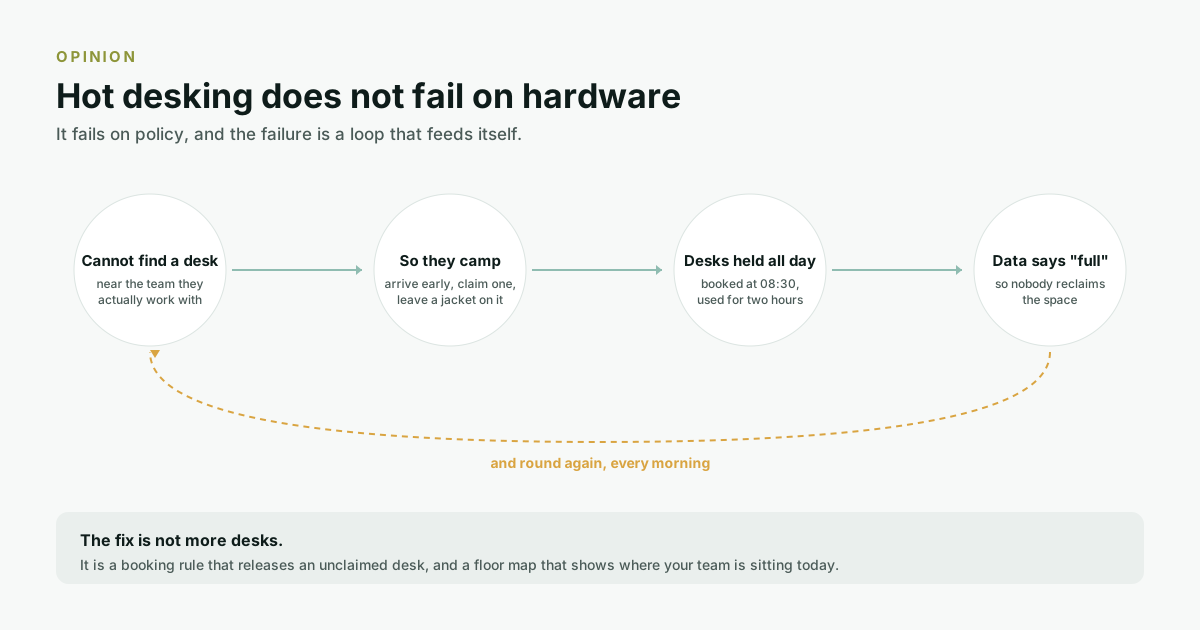
The loop
Four steps, each a rational response to the one before it.
Step one: people cannot sit with their team
This is the origin of everything else. Work is not individual. A designer needs to sit near the researcher; a junior needs to overhear the senior. A booking system that treats desks as interchangeable units optimises for the wrong thing, because a desk on the wrong floor is not a substitute for a desk beside your colleague. It is a worse outcome than working from home, which is the actual alternative on offer.
Step two: so they camp
Faced with that risk, people do the sensible thing. They arrive early, claim a desk in the right zone, and defend it. Some book weeks ahead. Some leave a jacket and a monitor cable as a territorial marker. This is not misbehaviour; it is a correct response to an unreliable system.
Step three: desks are held, not used
A desk booked at 08:30 and occupied for two hours reads as fully utilised to any system that measures bookings. The floor is full according to the booking data and visibly empty at 15:00 to anyone standing on it.
Step four: the data says the office is full
So nobody reclaims the space, nobody rebalances the floor, and the original problem, not enough desks in the right zone, is now invisible, because the measurement system is reporting the symptom of the problem as evidence that everything is fine.
Breaking it in three places
1. Release unclaimed desks automatically
A booking that is never claimed should expire. This single rule removes the profit from camping. Booking three days ahead stops being a way to guarantee a desk and starts being a way to lose one at 10:15, and it is the difference between booking data and occupancy data.
It has to be enforced by the system and communicated before it starts, because the first time somebody loses a desk they booked, it will feel like the system is broken rather than working.
2. Book zones, not coordinates
People do not want desk 4B-17. They want to be near their team. Letting a team claim a neighbourhood, with individuals floating inside it, resolves the step-one problem without reintroducing assigned seating. This is a policy decision that booking software can support but not make.
3. Show people where their colleagues are
Half the anxiety driving camping is not knowing. A floor map showing who from your team has booked what, today, removes the reason to arrive at 07:45 defensively. It is a small feature that does disproportionate work on behaviour.
Where the hardware does help
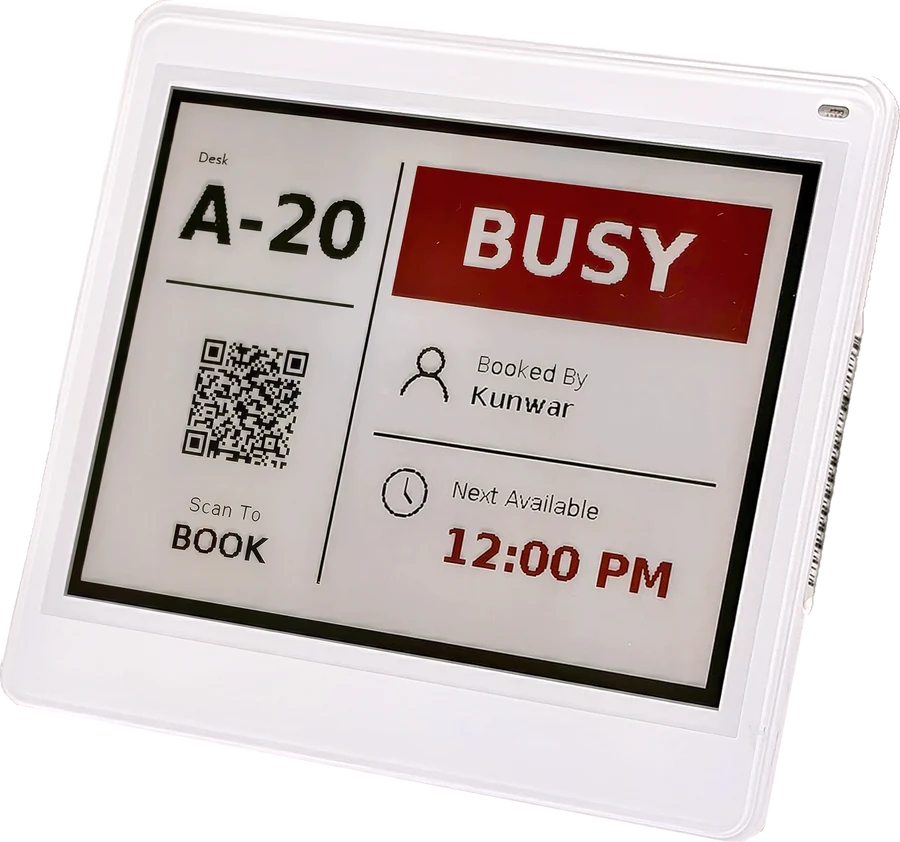
The policy sets the rules. The hardware is what turns them into something that happens on the floor rather than something written in a handbook.
- It makes state visible where the decision is made. Someone standing in front of a desk can see whether it is free without opening an app, which is the only moment the answer matters.
- It gives you a claim action. A release rule needs a way to say "I am here". A QR scan at the desk closes that loop without a separate app journey.
- It produces utilisation data that is about desks rather than about bookings, which is the input the whole programme was supposed to generate in the first place.
Hotdesk Tags do all three. Decide the release rule first and the tags are what make it real: a desk that returns to the pool because nobody claimed it, a scan that takes two seconds, and utilisation data that finally describes desks rather than intentions.
If you are about to start
- Decide the release rule before you buy anything. How long does an unclaimed desk stay held? Fifteen minutes? An hour? Until 11am? This is the single most consequential decision in the programme.
- Map teams to zones, and give teams enough desks in their zone for a realistic peak day rather than an average one.
- Announce the release rule twice before enforcing it, and enforce it on a date people know in advance.
- Measure occupancy, not bookings, and be ready for the first month's numbers to be worse than your booking data claimed.
- Revisit the zones after a quarter. The first allocation will be wrong; the point of the data is to find out how.
The uncomfortable part
If the honest occupancy data shows the office is half empty on Tuesdays, the correct response might be to reduce the floor rather than to improve the booking system. That is a real outcome of doing this properly, and it is worth deciding in advance whether the organisation actually wants the answer before it commissions the measurement.
Start with one floor
If you are running a programme now, the fastest useful thing is to measure what you actually have. Occupancy data against your existing booking data will tell you within a fortnight whether your problem is a shortage of desks or a shortage of released ones, and those two have completely different fixes.
Hotdesk Tags and truIoT are the two halves of that measurement, and they work on the floor you have today rather than requiring one you have to build first. Talk to a solution architect about running it on a single floor before you decide anything about the rest.
Frequently asked questions
Why do hot desking programmes fail?
Usually because people cannot reliably sit near their team, so they arrive early and camp on desks. Camped desks are held all day but used for a fraction of it, which makes booking data report the office as full when it is half empty, so the underlying shortage stays invisible.
What is the single most important hot desking policy decision?
The release rule: how long an unclaimed booking is held before the desk is returned to the pool. It removes the incentive to book defensively and is what turns booking data into occupancy data. Decide it before choosing any software.
What is the difference between booking data and occupancy data?
Booking data measures intent: someone reserved a desk. Occupancy data measures reality: someone sat at it. A programme with only booking data will conclude it needs more desks when it actually needs the desks it has to be released when unused.
Should people book a specific desk or an area?
An area, in most cases. People want to be near their team rather than at a particular coordinate. Letting a team claim a neighbourhood, with individuals floating inside it, solves the real need without reintroducing assigned seating.
Do desk tags fix hot desking adoption?
No. They make desk status visible at the desk, give people a way to claim a booking, and produce utilisation data about desks rather than bookings. All three are useful, and none of them writes the policy that determines whether the programme works.
What if the occupancy data shows the office is half empty?
Then the correct response may be to reduce the floor rather than improve the booking system. That is a genuine possible outcome, and it is worth deciding in advance whether the organisation wants that answer before commissioning the measurement.